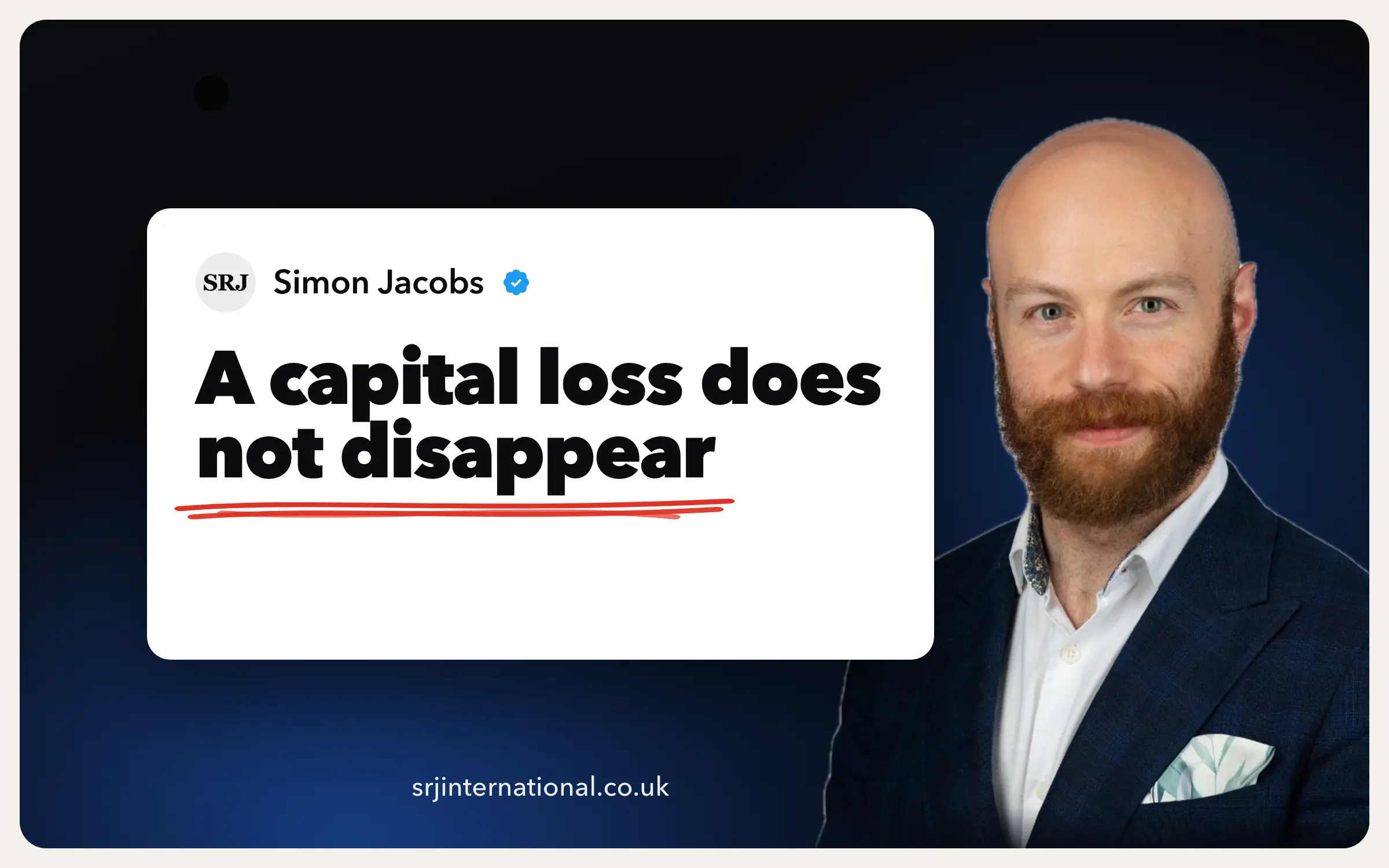
In short: A company capital loss goes against capital gains in the same accounting year, and anything left over carries forward indefinitely. What it will never do is reduce your trading profits.
If your company makes a capital loss, say from selling shares, property, or other business assets at a loss, here's what you can actually do with it.
What you can do with a company capital loss
1. Offset it against any capital gains made in the same accounting year
2. If there's nothing to offset it against this year, carry it forward indefinitely
3. Use it against capital gains in future years, whenever they arise
Can a capital loss reduce your trading profits?
One thing to flag: capital losses can only be set against capital gains, never against your trading profits.
How that plays out in practice
Here's an example: your company sells some shares this year and makes a capital loss of £30,000. You've got no other capital gains this year, so there's nothing to offset it against right now. That loss doesn't disappear, it carries forward.
2 years later, you sell a commercial property and make a capital gain of £50,000. You can offset the £30,000 loss against it, meaning you only pay corporation tax on £20,000 of that gain instead of the full £50,000.
Why the record-keeping matters more than it sounds
Keep a clear record of capital losses as they arise, because if they're not tracked properly, they can get missed and end up costing you tax you didn't need to pay.
A capital loss is a different animal from a trading loss. A trading loss can go back against an earlier profitable year and return corporation tax you have already paid, which is worth knowing if that is the position you are in: here is how carrying a trading loss back works. If it is a share sale you are weighing up, the tax on selling stocks and shares covers where the gain itself lands.
The figures above are an illustration, not a client case. This is general information rather than advice on your own numbers. A capital loss has to be notified to HMRC in a quantified amount before it can be used, and there are time limits and anti-avoidance rules that can restrict it, so check the current position or take advice before you file. If you want your own loss position worked through, see how we work or talk to us.
Common questions
There is no time limit on carrying an unused capital loss forward. HMRC states that the gains included in a company's corporation tax profits are the gains of the accounting period less allowable capital losses accruing in the same accounting period and losses of any previous period which have not been set against earlier gains, under TCGA92/S2A. See HMRC's [Capital Gains Manual, CG40200](https://www.gov.uk/hmrc-internal-manuals/capital-gains-manual/cg40200).
No. A capital loss is deducted from chargeable gains, and it is the net figure after that deduction which forms part of the company's profits for corporation tax. So a capital loss reduces gains, never trading income. That is the opposite of a trading loss, which is set against profits rather than gains.
Yes, and this is the part that catches people out. HMRC is explicit that a company must give notice of a loss for it to be an allowable loss, that the amount must be quantified, and that the notice must usually be given within four years of the end of the relevant accounting period. In practice that notice is the loss appearing in the return and computations. A loss nobody recorded at the time is a loss you may not be able to use later, which is why tracking them as they arise matters. See [CG40200](https://www.gov.uk/hmrc-internal-manuals/capital-gains-manual/cg40200) and [CG15800](https://www.gov.uk/hmrc-internal-manuals/capital-gains-manual/cg15800).
For most owner-managed companies, no. There is a restriction on relief for carried-forward losses where profits exceed a deductions allowance of up to £5 million, and HMRC confirms the restriction for carried-forward capital losses has effect for chargeable gains accruing from 1 April 2020. HMRC also states there is no restriction where qualifying profits sit below that allowance, and that it is unlikely to affect most small companies or groups. See [CTM05010](https://www.gov.uk/hmrc-internal-manuals/company-taxation-manual/ctm05010).
Related reading

Simon Jacobs is a Chartered Tax Adviser (CTA · ACA) and PwC trained, founder of SRJ International. He advises UK business owners on tax, profit extraction and exit. Read his full profile →