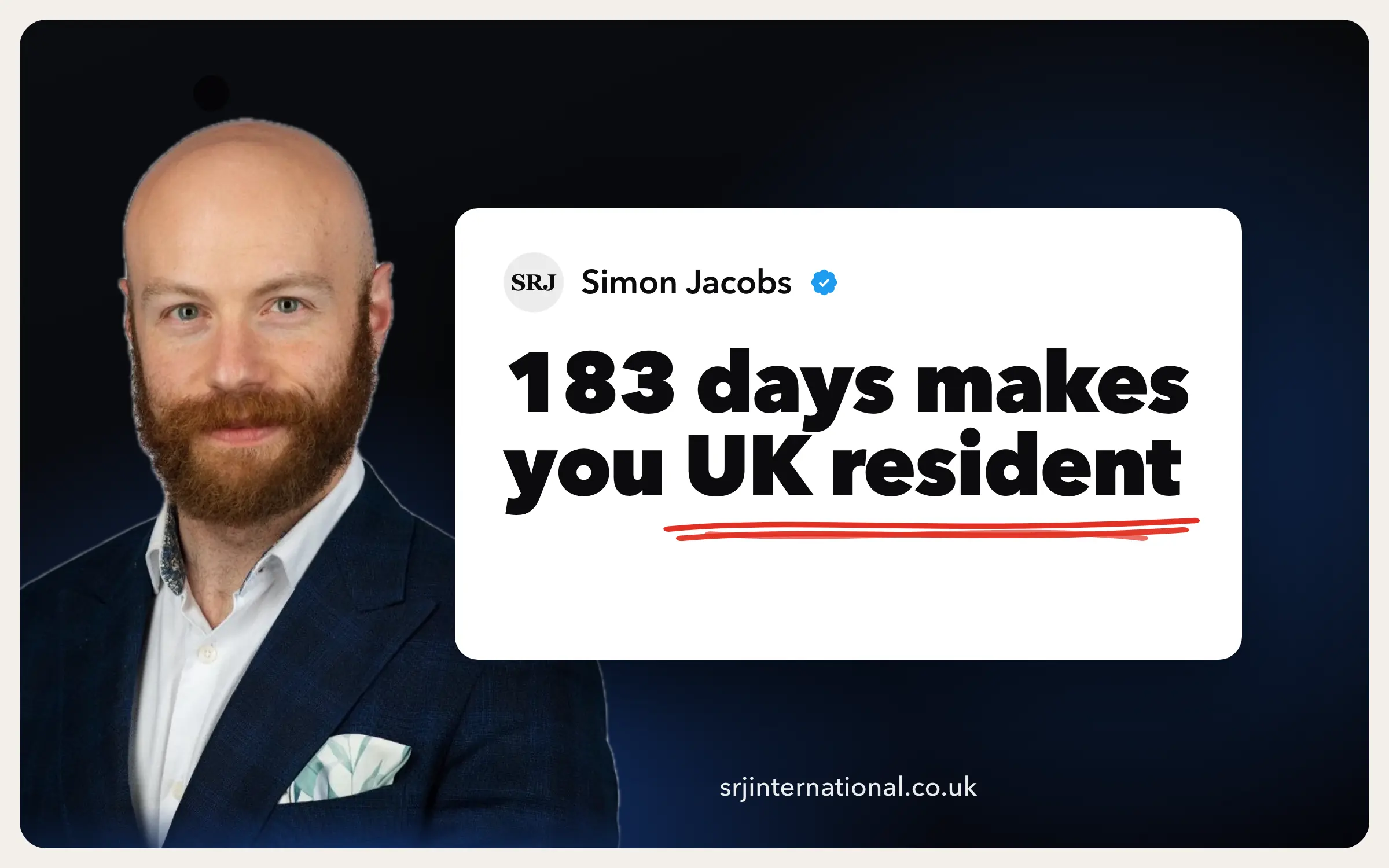
In short: Yes. Under the Statutory Residence Test, spending 183 days or more in the UK in a tax year makes you UK resident for that year. HMRC says no other test needs to be considered.
He lived in Ireland. He still owed thousands in UK tax.
Four years running, he spent more than 183 days a year in the UK. His previous accountant told him he was non-UK resident because that's where he lived.
That's not how it works.
What is the 183 day rule in the Statutory Residence Test?
The first automatic UK test in the Statutory Residence Test is simple: 183+ days in the UK in a tax year, and you're UK tax resident. Automatically. It doesn't matter where you call home.
HMRC's guidance note RDR3 sets out the test, which has applied since 6 April 2013. It says that if you have been in the UK for 183 or more days you will be a UK resident, and there is no need to consider any other tests. The first automatic UK test is worded the same way: you are UK resident for the tax year if you spend 183 days or more in the UK in that tax year, which runs from 6 April to 5 April.
Does it matter where your home is?
He met that test every single year for four years. Nobody checked.
RDR3 says each tax year is looked at separately, so you can be resident in the UK in one year and not the next. Four years over 183 days is four separate years of UK residence.
Where your home is does appear in the test, but further down. The second automatic UK test looks at whether you have a home in the UK, and the sufficient ties test weighs connections such as family, accommodation and work against your day count. HMRC's steps only send you to those tests if you have been in the UK for fewer than 183 days in the tax year.
The count itself can need care. RDR3 says your UK day count may be reduced for days spent in the UK because of exceptional circumstances, and increased by what it calls the deeming rule.
Being resident somewhere else does not rule out UK residence. HMRC's guidance says you can be resident in both the UK and another country, and that you will need to check the other country's residence rules and when its tax year starts and ends.
What does UK residence mean for your tax?
HMRC's guidance says residents normally pay UK tax on all their income, whether it is from the UK or abroad, and non-residents only pay tax on their UK income. It also says you may be able to claim tax relief if you are taxed in more than one country.
What happens when it comes to light years later?
The result: interest on tax that should've been paid years earlier, penalties for under-declared income, a bill that landed all at once instead of spread across four years, and HMRC scrutiny.
He hadn't done anything wrong himself, the advice he relied on was.
HMRC's guidance on compliance checks says that if you owe more tax after a check, you will be asked to pay it within 30 days and will normally have to pay interest from the date the tax was due. You may also have to pay a penalty. In deciding that, HMRC looks at the reasons why you underpaid, whether you told them as soon as you could, and how helpful you have been during the check.
Who should check your residence status?
Here's the lesson: a chartered accountant isn't automatically trained in residence and international tax. It's its own specialism. If you live or work across borders, make sure the person doing your return actually knows this world, not just accounting.
Being compliant only helps if the advice is right.
HMRC has a residence status checker that covers the current tax year or any of the previous 6. Its guidance says the result is an indication of whether you were UK resident, and the checker asks for the days you spent in the UK and abroad, your working hours, your family in the UK and your UK home.
We cover this area on our international tax page, and there is more in tax when you move abroad.
The residence rules and HMRC's guidance change, and your status depends on your own day counts and ties in each tax year, so this is general information rather than advice on your position. If you split your time between the UK and another country, talk to us or see how we work.
Common questions
There is no single number. HMRC's guidance says 183 days or more in a tax year makes you UK resident, but you can be resident on fewer days under the other automatic UK tests or the sufficient ties test, where the more UK ties you have, the fewer days you can spend here. See [RDR3: Statutory Residence Test (SRT) notes](https://www.gov.uk/government/publications/rdr3-statutory-residence-test-srt/guidance-note-for-statutory-residence-test-srt-rdr3).
It is the test used to work out your UK residence status for a tax year, in force since 6 April 2013. HMRC's guidance says it takes into account the time you spend and work in the UK and your connections with the UK, and is split into automatic overseas tests, automatic UK tests and a sufficient ties test. See [RDR3: Statutory Residence Test (SRT) notes](https://www.gov.uk/government/publications/rdr3-statutory-residence-test-srt/guidance-note-for-statutory-residence-test-srt-rdr3).
Yes. HMRC's guidance says you can be resident in both the UK and another country, and that you will need to check the other country's residence rules and when its tax year starts and ends. HMRC has separate guidance on claiming double taxation relief if you are dual resident. See [Tax on foreign income: if you're taxed twice](https://www.gov.uk/tax-foreign-income/taxed-twice).
HMRC's guidance says residents normally pay UK tax on all their income, whether it is from the UK or abroad. Non-residents only pay tax on their UK income and do not pay UK tax on their foreign income. See [Tax on foreign income: UK residence and tax](https://www.gov.uk/tax-foreign-income/residence).
Related reading




Simon Jacobs is a Chartered Tax Adviser (CTA · ACA) and PwC trained, founder of SRJ International. He advises UK business owners on tax, profit extraction and exit. Read his full profile →